

DoblAI: AI for easy and fast dubbing of multimedia content
February 2, 2026
RegBCN: Regenerating housing and community spaces in Barcelona
March 17, 202616/02/2026
Researchers from the Universitat Politècnica de Catalunya - BarcelonaTech (UPC) affiliated with the Advanced Communications Centre (CCABA) have developed a unique infrastructure serving the UPC, research centres and companies for the experimentation and validation of technologies and services using next-generation networks. This platform enables the validation of 5G solutions in real-world scenarios and leads research towards 6G, facilitating technology transfer to the market.
A key challenge: bringing advanced connectivity from the laboratory to real environments
The digitalisation of industry, mobility, public services and smart cities depends directly on the evolution of communication networks. Advanced 5G and future 6G enable new capabilities — ultra-low latency, high reliability, automation and intelligent resource management — that make it possible to develop new business models and high-value digital services.
However, for many companies the main obstacle remains the lack of real infrastructures where these technologies can be tested before commercial deployment. 6G LABNET UPC was created precisely to address this challenge, reducing technological risks and enabling the validation of innovative solutions in a controlled yet real environment.
A comprehensive solution: an open 5G/6G testbed in a real-world environment
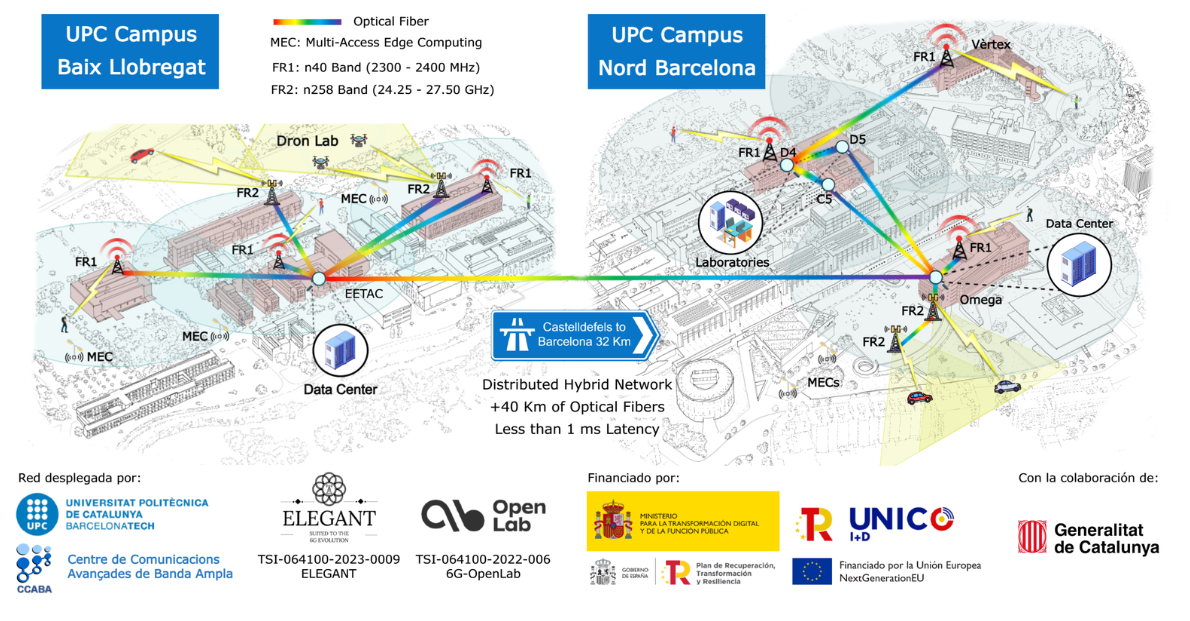
6G LABNET UPC is a physical R&D infrastructure that enables the design, validation and optimisation of solutions based on advanced 5G networks and future 6G technologies through a multi-technology end-to-end architecture.
The platform integrates:
- 5G mobile networks in the 2.3 GHz and 26 GHz bands (FR1 and FR2).
- A high-capacity, ultra-low latency WDM optical network.
- Edge computing and cloud-native architectures.
- Next-generation Wi-Fi (Wi-Fi 6) and Time-Sensitive Networking (TSN).
- Geo-redundant 5G cores to ensure service continuity.
The infrastructure connects the Nord (Barcelona) and Baix Llobregat (Castelldefels) campuses of the UPC over more than 30 km through a hybrid fixed–mobile network, enabling digital services to be validated under real operational conditions.
This environment supports companies in developing and validating:
- Industry 4.0 solutions
- Advanced robotics
- Connected and autonomous mobility
- Augmented reality and real-time video
- Artificial intelligence-based applications
- High-traffic density services
A unique infrastructure in Spain and a European benchmark
6G LABNET UPC is built on an open and flexible network capable of adapting to different use cases and business needs. It stands out for its technological capabilities and its open approach to business innovation, reducing development time, minimising deployment risks and improving operational efficiency:
Real distributed network
- Connection between Barcelona and Castelldefels (34 km).
- Validation in real geographical scenarios beyond the laboratory.
Hybrid fixed–mobile architecture
- Integration of advanced 5G networks with high-capacity optical transport (5G + optical hybridisation).
- End-to-end performance evaluation under operational conditions.
Open end-to-end environment
- Experimentation in millimetre-wave bands (up to 26 GHz) in real urban environments.
- Platform accessible to companies, start-ups and international consortia.
Optimisation through AI and big data
- Network automation and intelligent control.
- Advanced management of large data volumes.
Validation in critical scenarios
- Ultra-low latency and high-reliability testing.
- Real use cases in connected mobility (sensorised and connected commercial vehicle, 6G-EWOC project) and agrotech (intelligent crop monitoring at Agròpolis).
Institutional support
- European Next Generation funding and the UNICO 5G programme.
- Support from the Ministry for Digital Transformation and in collaboration with the Government of Catalonia.
Services tailored to businesses
6G LABNET UPC operates as a technological platform supporting business innovation, offering:
Technological validation
- Testing of 5G/6G products (hardware and software).
- Performance verification prior to commercial deployment.
Development of new digital services
- Application testing with strict latency, reliability or bandwidth requirements.
- Evaluation of cloud-native and edge computing architectures to optimise performance and user experience.
Field trials in real environments
- Field trials on 5G networks evolvable towards 6G.
- Multi-operator and multi-domain scenarios through end-to-end network slicing.
Advanced experimentation
- Network virtualisation.
- AI-based automation and “zero-touch” services.
- On-demand services.
Training and technology transfer in 5G+/6G environments
- Specialised training for technical teams.
- Workshops and technology demonstrators.
Expert support from UPC
UPC research groups and centres contribute their expertise in the design of advanced network architectures, integration of access and transport technologies, virtualisation, edge computing and artificial intelligence applied to telecommunications.
This capability allows the infrastructure to be adapted to the specific challenges faced by companies and supports them throughout the entire innovation cycle — from proof of concept to field validation — strengthening the role of UPC as a leading technological partner.¡
Budget and Consortium
6G LABNET UPC is the result of the development of the ELEGANT and 6G OpenLab projects, led by the UPC in collaboration with the Government of Catalonia.
The total budget for both projects amounts to €4 million, funded by European funds channelled through the UNICO 5G R&D programme of the Ministry for Digital Transformation and Public Administration.
The ELEGANT project started in April 2023 and 6G OpenLab in September 2022, and both were completed in December 2025.
Further information: CCABA: 6G LABNET UPC
Technology
You want to know more?
Related Projects
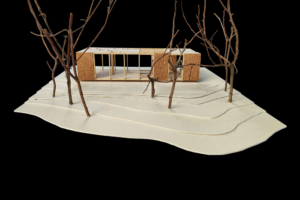
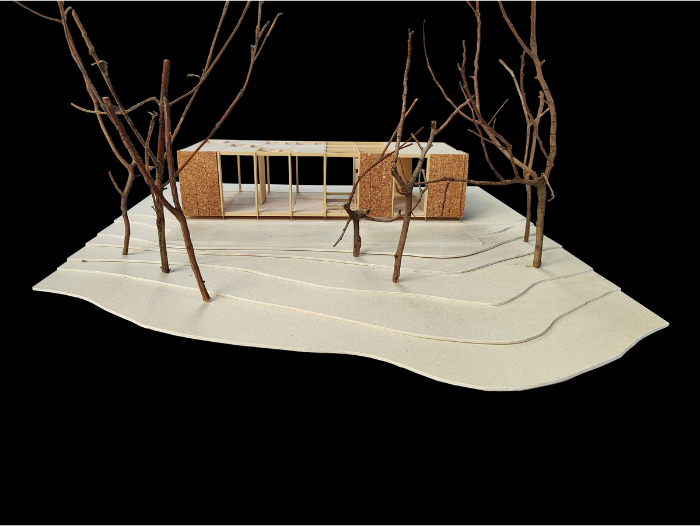
- The Casa Bosc project explores a lightweight, modular and prefabricated timber construction system designed to reduce the environmental impact of housing while making it easier to build and adapt to different contexts. The project has been developed by researchers from the Architectural Rehabilitation and Restoration Research Group (REARQ) at the Universitat Politècnica de Catalunya - BarcelonaTech (UPC) and the company ÀGORA.
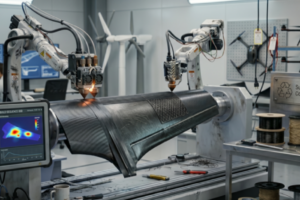
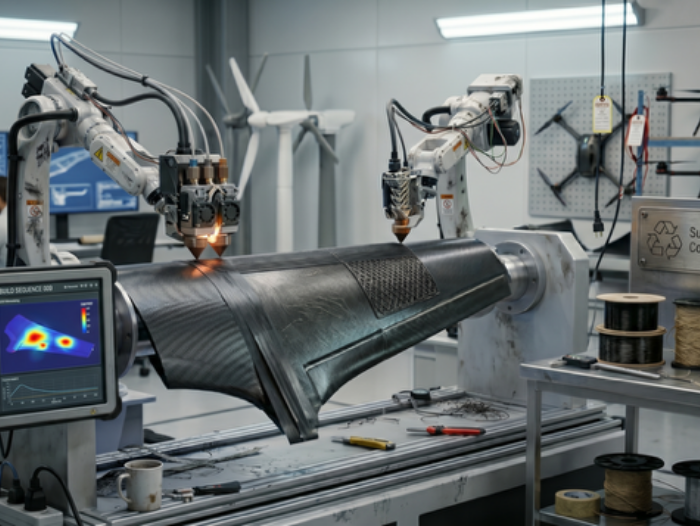
- The Control, Data and Artificial Intelligence (CoDAlab) research group at the Universitat Politècnica de Catalunya - BarcelonaTech (UPC) is taking part in the ATHENS project, which is developing recyclable thermoplastic composite materials with advanced real-time monitoring systems to improve the manufacture, safety and service life of lightweight structures.
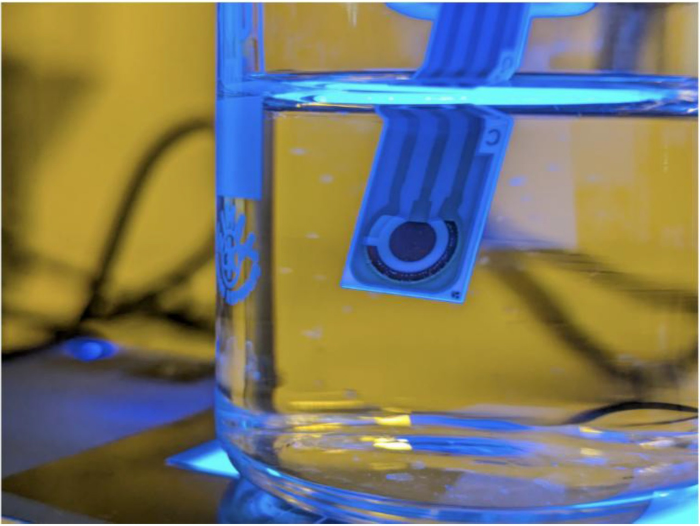
- The MICROTECH LAB - Microtechnology for the Industry research subgroup, part of the Centre for Advanced Technologies in Mechanics (CATMech) at the Universitat Politècnica de Catalunya - BarcelonaTech (UPC), is leading the technical development of a minimally invasive platform to monitor biomarkers and physiological indicators related to stress and emotional wellbeing.
- A research team from the Universitat Politècnica de Catalunya - BarcelonaTech (UPC) has participated in the M3LEC project, coordinated by the Centro de Astrobiología (CAB), a joint centre of the Spanish National Research Council (CSIC) and the Instituto Nacional de Técnica Aeroespacial (INTA), with the Universidad de Sevilla (US) / Instituto de Microelectrónica de Sevilla (IMSE) also participating. M3LEC aimed to contribute to the characterisation of the Martian atmosphere and meteorology, and to investigate new instrumentation for future planetary exploration missions.