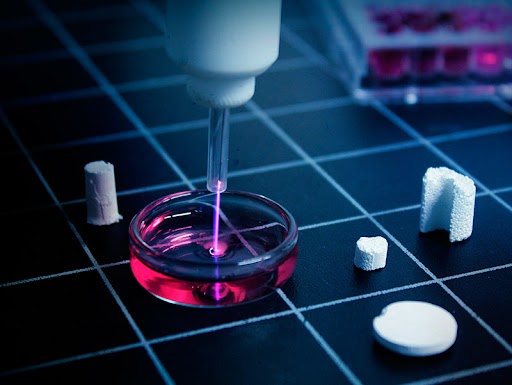


Research in this area focuses on materials for hard tissue replacement and generally engaged in an eminently structural function. These tasks include both mechanical characterization, microstructural and chemical fabrics and materials and the development of new materials and bioactive surfaces.
Development of biomaterials for tissue and organs regeneration/functional repair. It requires the design of materials able to modulate the response of the desired tissue leading, in some cases, to the regeneration and formation of the degraded tissues, or to the perfect integration of the biomaterial and the recovery of the lost functionality.
- Injectable calcium phosphates for bone replacement and regeneration
- Metallurgy and coatings
- Shape memory alloys (low elastic modulus alloys for the manufacture of implants and prostheses)
- New biomaterials from biodegradable compounds for bone regeneration
- Bioactive surfaces on titanium and its alloys
- Cell bioengineering
- Cell cultures
- Biodegradable scaffolds
- Surface characterization
RELATED PROJECTS
- Participants in the HybridNeuro project include researchers from the group BIOART, which is part of the CREB of the UPC. The project is designed to establish a new way of analysing the motor system and human musculoskeletal movements, and the transfer of academic research to clinical practice and industry.
- Researchers from the Plasmas for BioMedical Applications Laboratory (PlasmaMED Lab) of the Department of Materials Science and Engineering of the Universitat Politècnica de Catalunya - BarcelonaTech (UPC), are working to develop a new treatment for bone cancer, which avoids the secondary effects of conventional treatments – such as chemotherapy – and enables bone regeneration when the tumour has been surgically resected.
- The production of biogas through anaerobic digestion has been increasing exponentially in Europe in recent years. This is because it can be produced locally and has a clear positive effect on waste recycling, the generation of clean energy, sustainable development or climate action. In this context, the FertiLab project was launched, with the participation of researchers from the Department of Agri Food Engineering and Biotechnology (DEAB) of the UPC.
- The Construction Engineering (EC) Research Group of the Universitat Politècnica de Catalunya (UPC) is participating in the NEUROCRETE project.