

Micromechanical design to optimise materials for tools
December 31, 2019
New additive manufacturing precosses for metal components
December 31, 2019The regeneration and repair of non-functional tissues is an extremely significant challenge at global scale, due to the increase in life expectancy and prevalence of ageing-related diseases. In the case of bone-joint disorders, it is vital to develop new strategies for regeneration of the bone tissue that reduce the limitations of current treatments, which are mainly based on the use of grafts, often require second surgery and may lead to morbidity of the patient, among other disadvantages. The fact that bone is the second most transplanted tissue after blood, with 2.2 million procedures carried out annually worldwide, shows the relevance of developing new biomaterials in this area. One of the common strategies for improving bone regeneration is the use of bone morphogenetic proteins (BMP), a growth factor with high osteogenic potential. However, its clinical use is associated with severe complications (formation of ectopic bone, dysphagia, dyspnea and cancer, among others) and it is currently a cause of controversy.
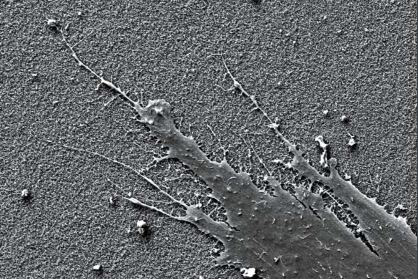
To respond to the difficulties resulting from the clinical use of BMP, as part of the MIMESIS project, the Biomaterials, Biomechanics and Tissue Engineering (BBT) research group at the Research Centre for Biomedical Engineering (CREB UPC) has developed new mimetic molecules of BMP. The aim is to obtain new biomaterials with high osteogenic potential and great capacity to regenerate the bone.
The methodology that has been developed can be used to functionalise a large number of medical implants, from dental implants and orthopedic prostheses to hydrogels and polymers. The results obtained at cell level in vitro show that this methodology leads to a highly beneficial response in the cells responsible for forming bone. Currently, studies are being carried out in animals to assess its preclinical potential.
The project is funded by the Spanish National Plan for Scientific and Technical Research and Innovation 2013–2016, as part of the programme Research Challenges: Research, Development and Innovation projects. It will be completed in 2021.
Related Projects
- Researchers from the UPC are participating in the Quartz Enrichment Enabling Near-Zero Silicon (QUEEN) project, aimed at reducing the European Union’s dependence on external sources for critical raw materials, particularly metallurgical-grade silicon (MG-Si). To achieve this, the project proposes harnessing an underused resource: quartz sand from European quarries, to produce MG-Si locally, sustainably, and efficiently.
- A multidisciplinary team of researchers from the Research Group in Smart and Sustainable Resources and Industries (RIIS), the Sustainable Mining Research Group (GREMS), and the Construction Materials and Roads (MATCAR) group at the Universitat Politècnica de Catalunya – BarcelonaTech (UPC) is leading the VALORFIN project. The aim is to develop a technological solution for the valorisation of the fine fraction of construction and demolition waste (CDW), transforming it into new low-CO₂-emission cementitious materials, while also reducing the presence of hazardous materials in this waste.
- 08/07/2025Project Headerrightno-repeat;left top;;auto20px The research groups River Dynamics and Hydrological Engineering (FLUMEN) and Construction Materials and Roads (MATCAR) at the Universitat Politècnica de Catalunya – BarcelonaTech […]
- The Innovation in Materials and Molecular Engineering – Biomaterials for Regenerative Therapies (IMEM-BRT) research group at the Universitat Politècnica de Catalunya – BarcelonaTech (UPC), in collaboration with the Institute of Chemical Research of Catalonia (ICIQ), has developed polymer resins derived from plant-based materials to reduce the dependence of 3D printing on fossil fuel-based resins.