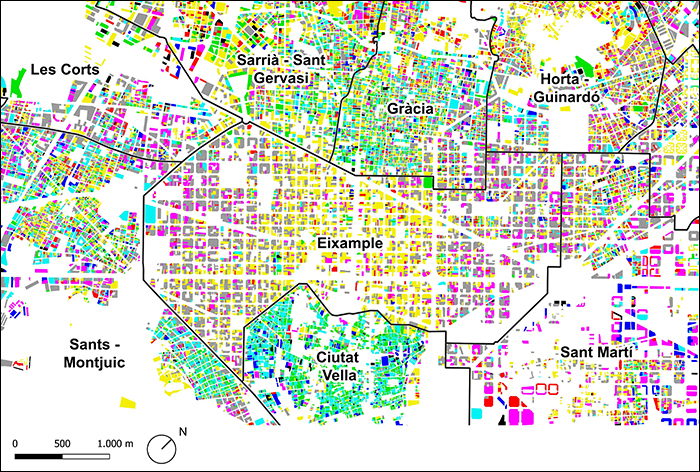


Cartography of Barcelona during the period of the first state of alarm due to the pandemic
July 8, 2021
A platform for identifying new antibiotics designed to combat multidrug-resistant bacteria
July 9, 2021The ICARUS research group leads the project ‘Drones against COVID-19. Propagation by Controlling Capacity in Public Spaces’, based on the idea that one of the key elements in the fight against COVID-19 is controlling the capacity at large events.
When events are in closed spaces, it is enough to control entrances. However, in public events in open spaces where the number of entrances is too great, the capacity can only be controlled from the air. The use of drones is proposed as a suitable measure, due to their low cost and the possibility of flying at a low altitude.

Research is being carried out to find a suitable model of drone to carry out this kind of task and to improve the models of neural networks that exist and train them to recognise people from a bird’s eye view. Beyond recognising and counting people, the aim is to test a new model that can detect groups of people based on images provided by the drone of the local police in Castelldefels, who are collaborating with the project. The research team will work to optimise an algorithm based on artificial intelligence techniques that can be executed in real-time on a mobile device (a tablet or telephone) connected to the drone. All of this will be achieved while respecting the protection of people’s data and privacy. The images that are captures will be anonymised by automatically putting the faces of the people out of focus.
The project is coordinated by the ICARUS research group, with the participation of Castelldefels City Council.
The project was one of four UPC projects selected for the call ‘Retreating to grow: the impact of pandemics in a world without visible borders’ (PANDÈMIES 2020) of the Agency for Management of University and Research Grants (AGAUR), for research projects whose aim is to analyse the impact of the COVID-19 epidemic specifically, and the concept of pandemic in general. The projects will be developed in a maximum of 18 months.

Related Projects
- The project is led by a team from the Rehabilitation and Architectural Restoration (REARQ) at the Universitat Politècnica de Catalunya - BarcelonaTech (UPC), in collaboration with the Interdisciplinary Group on Building Science and Technology (GICITED), also from UPC, and CONSTRAULA.
- The La Volta project foresees the construction of a large Catalan vault pergola within the Llars Mundet campus, in the Montbau neighbourhood (Horta-Guinardó district). This structure will become a new architectural landmark for Barcelona, combining traditional construction techniques with contemporary innovation. The project involves the Rehabilitation and Architectural Restoration Research Group (REARQ), at the Universitat Politècnica de Catalunya - BarcelonaTech (UPC), and is led by the Architects’ Association of Catalonia (COAC) and the Barcelona Provincial Council.
- The Architecture, Energy and Environment (AiEM) research group at the Universitat Politècnica de Catalunya - BarcelonaTech (UPC) has characterised Barcelona’s residential buildings according to their capacity to adapt to climate change. This study is part of the project ‘VeUvE: Urban havens for vulnerable zones’. The work highlights the climate inequality conditions present across different areas of the city and will help to better define the priorities and energy renovation strategies for its districts.
- The Research Center for Supervision, Safety and Automatic Control (CS2AC-UPC) at the Universitat Politècnica de Catalunya - BarcelonaTech (UPC) has coordinated the SaCoAV project, focused on researching new methods and tools to ensure the safe coordination of autonomous vehicles in urban environments.