

AMALEU: a universal representation of language based on automatic learning
December 16, 2019
Development of a sustainable biogas purification system
December 22, 2019The Architectural Rehabilitation and Restoration (REARQ UPC) research group has drawn up a technical report on the restoration of buildings 1, 2 and 4 of Can Bagaria, in Cornellà de Llobregat.
The aim of the report is to resolve a series of technical requirements based on the following actions: waterproof and insulate the gable roofs of mission clay tiles and the exposed tile vault ceilings, repair a cupula with an exterior finishing of trencadís, and restore the interior metal structure and the exposed brick façades of the factory. To define the most optimal solutions for each of these aspects, the report provided an analysis of the industrial complex through a study of its historical functioning (uses), construction and structural execution, and finally the state of the damage.

During the first technical inspection visits, a sensory examination was used to detect a range of faults that could represent a risk for the structural safety and the feasibility of the proposed solutions. This previous analysis of the damage revealed the need to check the construction solution and the functioning of each of the elements in the metal structure, the solution of struts and ties and the rainwater pipes, as well as the construction system of the various roofs. For this purpose, a series of prospections and inspections were carried out to characterise the building and define the scope of the impact.
The results can be used to verify some of the hypotheses about the architectural type in the historical and technological context of the territory. They lead to a construction and structural analysis using the study of specific treatments of the period, architectural parallels and the patents of construction systems that existed at the time.
It is crucial to understand how important it is to know the characteristics of a type of building as a starting point for decisions on proposals for restoration and change of use. In this case, the buildings are characterised by the clear geometry of their volumes, the rigour of their construction systems based on regularity and the use of suitable materials for durability over time, all of this accompanied by generously accurate dimensions. All of these characteristics probably maintain the flexibility and capacity of adaptation of the buildings.
Related Projects
- The La Volta project foresees the construction of a large Catalan vault pergola within the Llars Mundet campus, in the Montbau neighbourhood (Horta-Guinardó district). This structure will become a new architectural landmark for Barcelona, combining traditional construction techniques with contemporary innovation. The project involves the Rehabilitation and Architectural Restoration Research Group (REARQ), at the Universitat Politècnica de Catalunya - BarcelonaTech (UPC), and is led by the Architects’ Association of Catalonia (COAC) and the Barcelona Provincial Council.
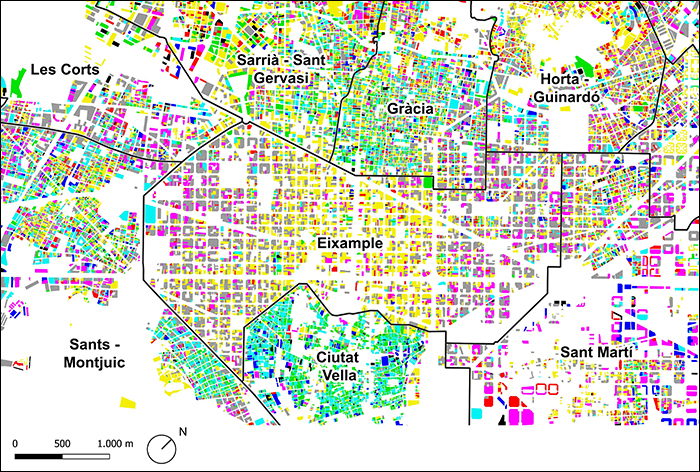
- The Architecture, Energy and Environment (AiEM) research group at the Universitat Politècnica de Catalunya - BarcelonaTech (UPC) has characterised Barcelona’s residential buildings according to their capacity to adapt to climate change. This study is part of the project ‘VeUvE: Urban havens for vulnerable zones’. The work highlights the climate inequality conditions present across different areas of the city and will help to better define the priorities and energy renovation strategies for its districts.
- The Research Center for Supervision, Safety and Automatic Control (CS2AC-UPC) at the Universitat Politècnica de Catalunya - BarcelonaTech (UPC) has coordinated the SaCoAV project, focused on researching new methods and tools to ensure the safe coordination of autonomous vehicles in urban environments.
- The Centre for Technological Risk Studies (CERTEC) at UPC is participating in the WUITIPS project (Wildland-Urban-Interface Fire Touristic Infrastructure Protection Solutions), which aims to develop a new wildfire management framework for the tourism sector. This project contributes to risk analysis and the design of specific strategies to mitigate such risks.