

HARMONIZE: Enhanced membrane distillation and crystallisation technologies for added-value ammonia products recovery approaching zero waste
May 13, 2025
Sustainable 3D Printing Resins Derived from Plant-Based Sources
May 23, 202520/05/2025
The Centre for Technological Risk Studies (CERTEC) at the Universitat Politècnica de Catalunya – BarcelonaTech (UPC) is leading the European Program for Wildfire-Prepared Communities (FIREPRIME), a project designed to develop tools and services for wildfire prevention in Europe, with the goal of improving safety in the wildland-urban interface by actively involving the community in its own protection.
As part of the project, a pioneering pilot test in wildfire prevention will be carried out in the neighbourhoods of La Floresta and Sol i Aire in Sant Cugat del Vallès, the first of its kind in Europe.
Wildfires are a growing problem across Europe. In recent years, fires of unprecedented scale and intensity have devastated several EU regions, increasingly threatening settlements located in wildland-urban interface areas and causing extraordinary damage.
To address this challenge, and inspired by existing frameworks in North America such as Firewise and FireSmart, the initiative aims to lay the foundations for a homegrown European programme to strengthen fire resilience in neighbourhoods and developments located at the wildland-urban interface. It focuses on three critical targets: homes, communities, and infrastructure.
The project seeks to establish the foundations for a European programme that promotes fire resilience in urban communities and to eventually transfer the lessons learned to other fire-prone regions across Europe. The programme will be launched through three pilot sites:
Catalonia (Sant Cugat del Vallès): The focus is on community preparedness and empowering residents of a predominantly urban population located in an area with a very high fire risk.
Austria (Haiming): The main challenge is the low perception of wildfire risk despite increasing threats. Efforts focus on raising awareness, particularly among property owners, tourists, and businesses.
Sweden (Kalmar County): The project works in a forest-rural interface area, with a highly scattered built environment made mostly of wooden structures and the presence of critical infrastructure such as railways. Key challenges include emergency response times and the traditional use of fire in a changing climate.
The Sant Cugat Pilot
One of the project’s flagship actions is the creation of a mobile app that will provide residents with tools to assess wildfire risk levels and receive recommendations on how to prevent and protect against fires. The mobile app, developed by UPC, will use a quantitative analysis based on fault tree diagrams to evaluate the likelihood of a building catching fire based on multiple factors (construction materials, garden maintenance, presence of vegetation, etc.).
Homeowners will answer questions about their property —such as construction materials, maintenance conditions, or surrounding vegetation— and, based on their responses, the app will generate a risk score. It will also provide tailored recommendations to reduce the risk and allow users to compare their score with the neighbourhood average, thereby promoting awareness and community engagement.
This pilot test is being conducted in the neighbourhoods of La Floresta and Sol i Aire in Sant Cugat del Vallès, chosen for their variety of housing developments and the strong involvement and awareness of residents regarding wildfire risks. The action began with a small group of local residents who are testing the app, and it will later be extended to the wider community, with complementary training and awareness activities for both adults and children.
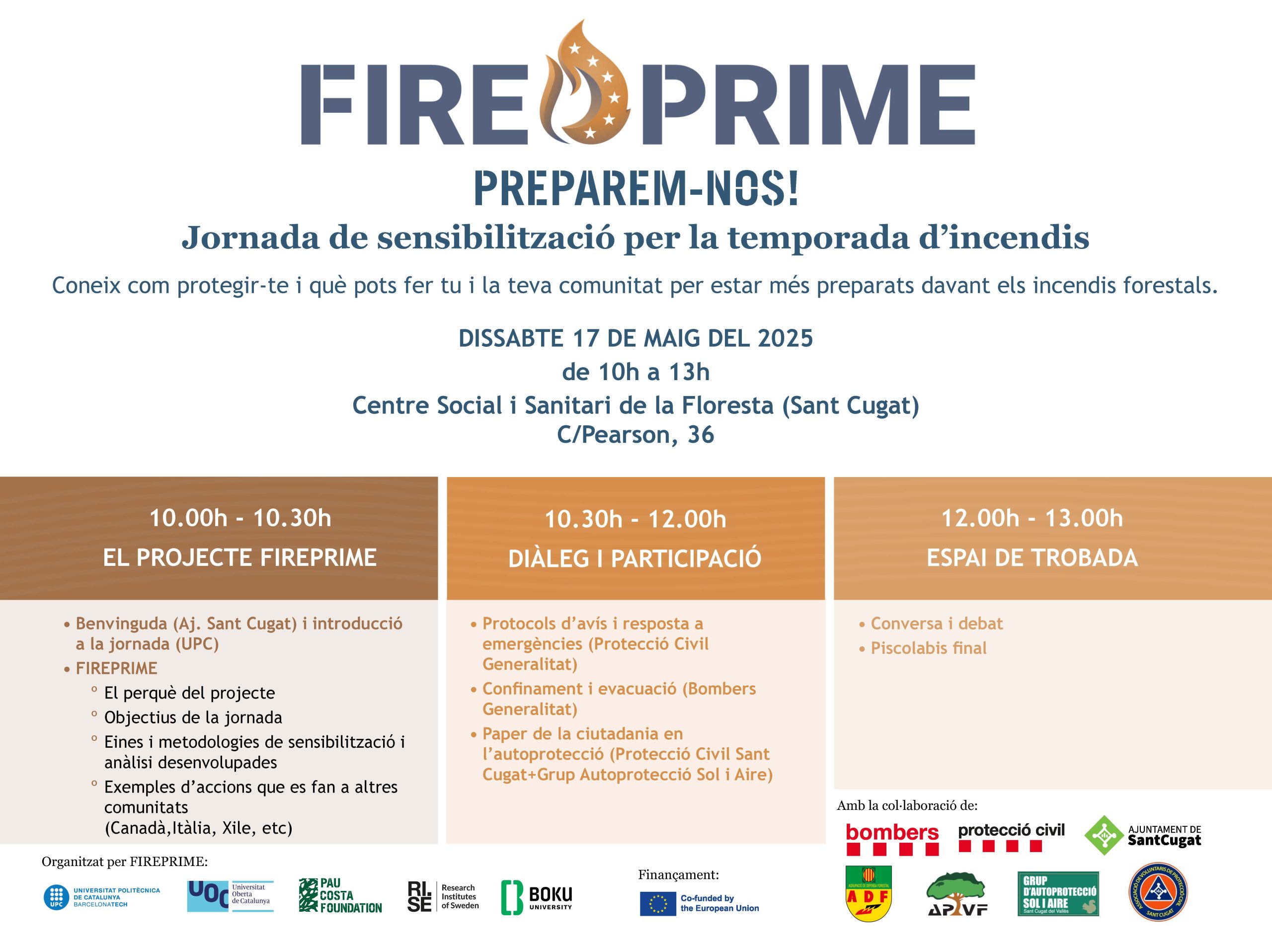
In parallel with the app development, the FIREPRIME project will roll out an educational and community engagement strategy tailored to the local context of Collserola. It will engage various community groups —including children, young people, homeowners, and people with functional diversity— through training sessions, volunteer activities, and wildfire preparedness days, such as the one scheduled for May 17 in La Floresta. During this event, Civil Protection and the Catalan Fire Department will engage with the public to discuss alert and emergency response protocols, evacuation and sheltering strategies, and self-protection actions.
The project is being implemented in collaboration with the Sant Cugat City Council, the Catalan Fire Department, Civil Protection, the Collserola Natural Park, the Sant Cugat Forest Defence Association (ADF), self-protection groups, and neighbourhood associations.
Impact
The FIREPRIME project will have a significant impact on how European communities respond to the growing risk of wildfires, particularly in areas where natural spaces border urban settlements. The project not only addresses the technical aspects of wildfire risk (vulnerability assessments, the app, forest management) but also strongly integrates social, cultural, and educational dimensions.
Consortium, Budget and Funding
FIREPRIME includes the participation of other UPC research groups, such as the Integrated Software, Services, Information and Data Engineering (inSSIDE) group and the Group of Software and Service Engineering (GESSI). Project partners also include the Pau Costa Foundation, the Universitat Oberta de Catalunya (UOC), the University of Natural Resources and Life Sciences in Vienna, and the Research Institutes of Sweden.
The project started in February 2024 and is expected to be completed by January 2026. It is funded with a total of € 673,698.



FIREPRIME is co-funded by the European Union Civil Protection (Project GA101140381, FIREPRIME UCPM-2023-KAPP).
Disclaimer:
Views and opinions expressed in this document are however those of the author(s) only and do not necessarily reflect those of the European Union or the European Commission. Neither the European Union nor the granting authority can be held responsible for them.
Related Projects
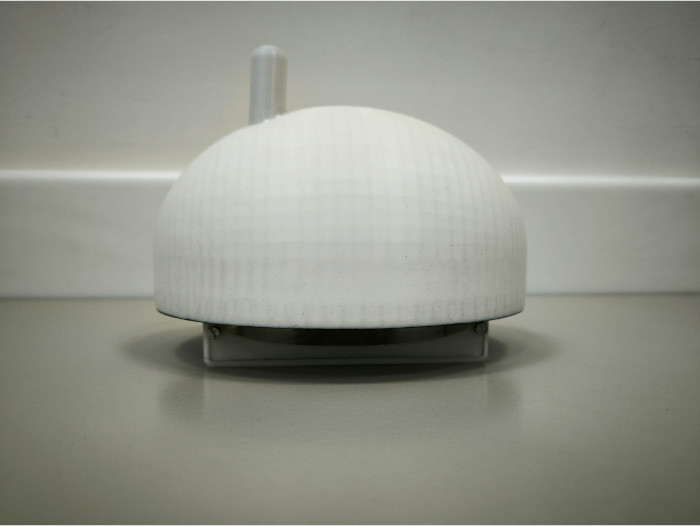
- Researchers from the Computer Networks and Distributed Systems (CNDS) research group at the Universitat Politècnica de Catalunya - BarcelonaTech (UPC) are developing new artificial intelligence-based solutions to obtain more accurate and reliable data from IoT sensor networks, with applications in air quality monitoring, anomaly detection and industrial predictive maintenance.
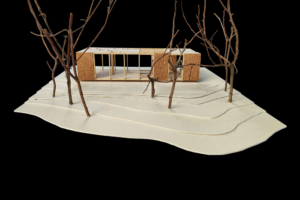
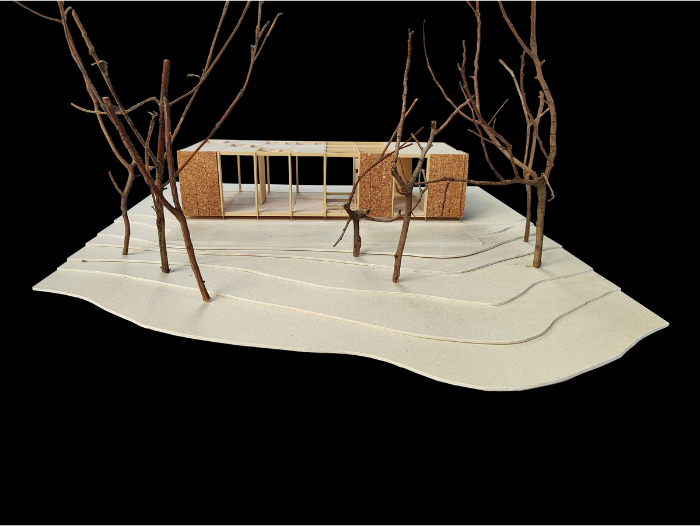
- The Casa Bosc project explores a lightweight, modular and prefabricated timber construction system designed to reduce the environmental impact of housing while making it easier to build and adapt to different contexts. The project has been developed by researchers from the Architectural Rehabilitation and Restoration Research Group (REARQ) at the Universitat Politècnica de Catalunya - BarcelonaTech (UPC) and the company ÀGORA.
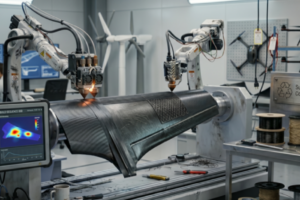
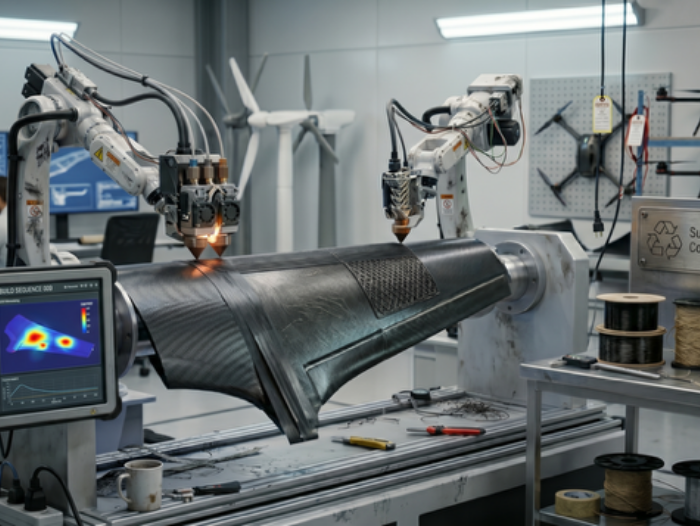
- The Control, Data and Artificial Intelligence (CoDAlab) research group at the Universitat Politècnica de Catalunya - BarcelonaTech (UPC) is taking part in the ATHENS project, which is developing recyclable thermoplastic composite materials with advanced real-time monitoring systems to improve the manufacture, safety and service life of lightweight structures.
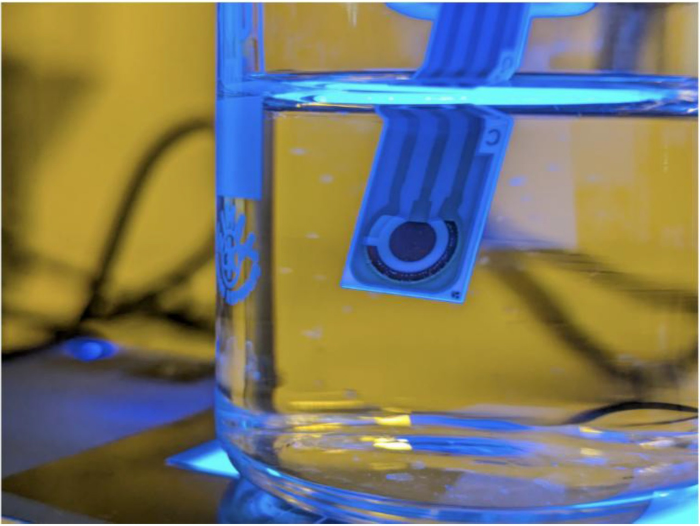
- The MICROTECH LAB - Microtechnology for the Industry research subgroup, part of the Centre for Advanced Technologies in Mechanics (CATMech) at the Universitat Politècnica de Catalunya - BarcelonaTech (UPC), is leading the technical development of a minimally invasive platform to monitor biomarkers and physiological indicators related to stress and emotional wellbeing.