


Digital twins with applications in the contructions sector
February 11, 2022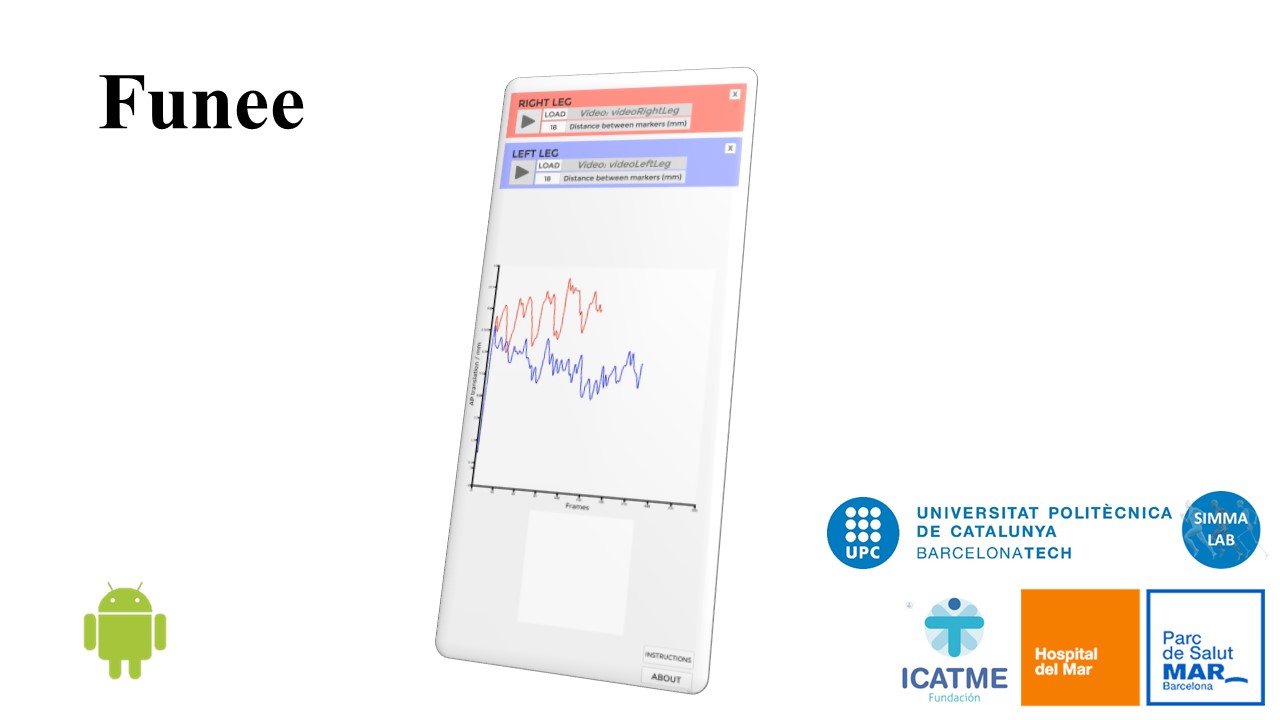
An application to assist the diagnosis of injuries to the anterior cruciate ligament of the knee
February 16, 2022The Multimedia Applications Laboratory (LAM UPC) has developed a mobile application that helps in the differential diagnosis between patients with Parkinson’s disease and essential tremor, using inertial sensors and artificial intelligence. This new technology is crucial for developing countries that lack more sophisticated diagnostic devices, while in developed countries this tool helps to reduce hospital costs and waiting lists.

Essential Tremor is a type of movement disorder that is frequently erroneously diagnosed as Parkinson’s disease. Essential Tremor is not degenerative and presents as a rhythmic tremor in movement that is generally accentuated for positions in posture. In contrast, Parkinson’s disease is of a neurodegenerative nature and mainly affects movement at rest. The treatment with dopamine that is administered to Parkinson’s patients is extremely aggressive and harmful if it is given to patients who do not suffer from this disease, for example, patients with Essential Tremor. In addition to this major drug contraindication, the test to determine whether a patient has Parkinson’s disease, Single Photon Emission Computed Tomography (SPECT), is extremely costly and often has long waiting lists. SPECT is an examination that requires the administration of a radiopharmaceutical (a source of gamma radiation) to the patient to identify the distribution in brain regions and determine the amount of neurodegeneration.
The mobile application that was developed is based on a biomechanical test in two positions (relaxation and posture) to register and analyse hand tremor with inertial sensors, whether using a mobile phone or specific wireless devices. The linear acceleration and/or angular velocity of the movements is processed to provide biometric characteristics of the patients in the time and frequency domain. Then, algorithms are used based on neural networks. The resulting values are compared with those obtained in diagnosed cases to determine whether the patient has Parkinson’s disease or Essential Tremor. Currently, the database is being expanded with the help of several hospitals and associations to improve the reliability of the tool for differential diagnosis. The diagnosis provided by the application will give doctors additional information on complex patients or patients in early phases in which the right treatment is vital to improve quality of life.
This new technology is accessible for developing countries that lack more sophisticated diagnostic devices.
The project is being developed in collaboration with the doctors Josep Valls and Eduard Tolosa, from the neurology unit of Hospital CLINIC, the Universidad Autónoma de Occidente de Colombia, Universidad de Chile and the Ostbayerische Technische Hochschule of Germany. The project will be end in 2022.
Sector
You want to know more?
Related Projects
- A team from the Bioinspired Oral Biomaterials and Interfaces (BOBI) research group at the Department of Materials Science and Engineering (CEM) of the Universitat Politècnica de Catalunya - BarcelonaTech (UPC) is taking part in the European project HYDROHEAL, which explores how to transform bone fracture treatment using smart and advanced biomaterials, aiming to reduce the risk of infection and implant rejection, as well as shortening fracture recovery times.
- Neurodegenerative diseases, such as Parkinson's disease, Alzheimer's, and age-related disorders, have been widely studied due to their significant impact on individuals and society. So far, these are incurable and debilitating diseases that lead to progressive degeneration and death of nerve cells, resulting in cognitive and mobility impairments. Tremors, mainly at rest, slowness of movement (bradykinesia), limb rigidity, and issues with gait and balance are typical motor disorders related to Parkinson’s disease. Additionally, due to progressive muscle atrophy, these issues can lead to falls, which in turn result in further complications and risks to quality of life.
- The Biomaterials, Biomechanics, and Tissue Engineering (BBT) Research Group at the Institute for Health Research and Innovation (IRIS) of the Universitat Politècnica de Catalunya – BarcelonaTech (UPC) is leading DYNAMIC, a project aimed at creating multifunctional, stimuli-responsive biomaterials that not only promote bone regeneration but also intelligently and effectively combat bacterial infections.
- 30/09/2024Project Headerrightno-repeat;left top;;auto20px A team from the Centre for Research in Biomedical Engineering (CREB) of the UPC and Sant Joan de Déu has created a new […]


