

Architectural model of the Sagrada Familia’s Nativity Facade in 3D
May 23, 2019
A system for monitoring the elderly based on gas sensors and artificial intelligence
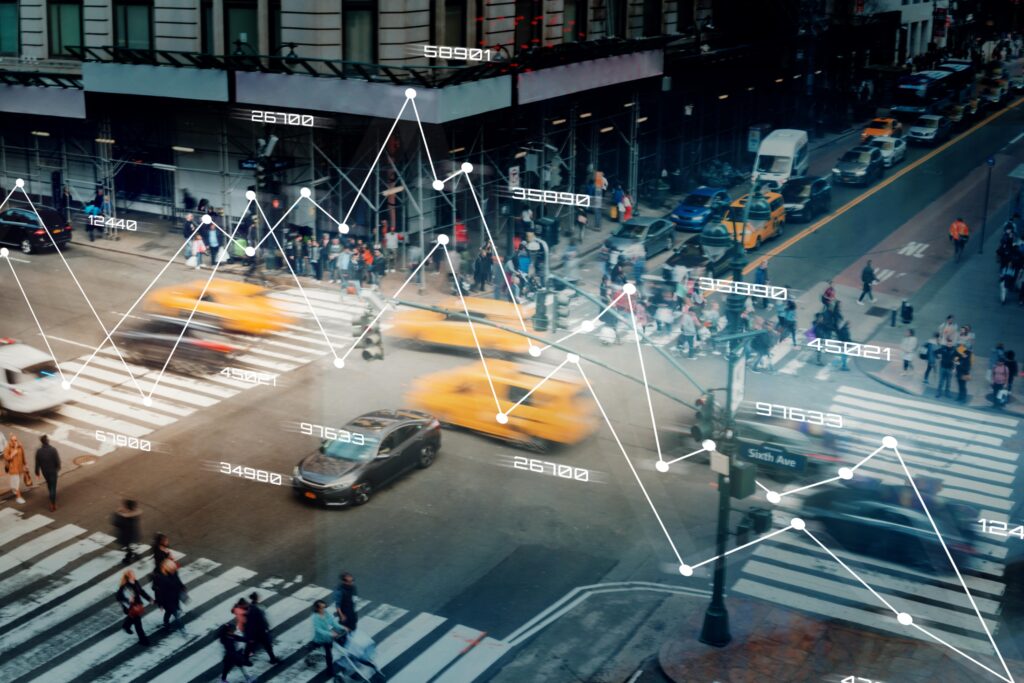
May 23, 2019inLab FIB UPC has completed the second phase of modelling transport in the first zone of Barcelona Metropolitan Area, as part of the Virtual Mobility Lab (VML) project, which is focused on developing new tools for urban planning.

VML is a methodological schema for analysing and assessing the impact of smart mobility projects in Barcelona, the results of which could be assessed before undertaking pilot projects. The aim is to support those who make decisions about mobility policies, as well as transport operators or new companies that develop new mobility alternatives and wish to assess them.
The first zone of Barcelona Metropolitan Area consists of 18 municipalities and has been divided into 630 transport zones (TAZ, Transport Analysis Zones) that are compatible with the administrative divisions (regions, municipalities, districts, census areas). Transport hubs have been considered specifically (for example, the airport). The city of Barcelona has been divided into around 350 TAZ on which this analysis is based.
In the first phase of the project, inLab FIB UPC develop the first detailed multimodal model of the Inner Ring of Barcelona Metropolitan Area that includes the offering of all public transport modes and private vehicles, and the mode demand of origin-destination (OD) mobility in 2017.
The second phase of modelling was designed to validate and partially calibrate the private transport model. In the past, transport data have come exclusively from government bodies. Now, inLab FIB has incorporated data from traditional sources into the study area at the level of day and time, as well as data from new technologies (mobile phones and geolocated fleets of vehicles). Processing these data enabled the initial construction of distribution of journeys between pairs of zones (origin-destination) in the study area. The results of the final model in the second phase of the project have been compared with the reference data at the level of the average day (data provided by the government, capacity and speeds and times from origin to destination from new technologies) satisfactorily.
In future phases of development, the calibration of public and private transport will be refined at the level of time bands.
The project is being developed in the hub of urban mobility, CARNET. The model of offering and demand for transport has been implemented in the commercial platform VISUM by PTV-AG. Other collaborators in the project are SEAT, PTV IBERIA, RACC, INRIX and Kineo.
Technology
Sector
Topic
You want to know more?
Related Projects
- The Barcelona Innovative Transportation (BIT), the Research Center in Automotive and Advanced Mobility (CER-AMA) and The Future Mobility Research Hub (CARNET) research groups from the Universitat Politècnica de Catalunya - BarcelonaTech (UPC) are participating in the E-MED project, which aims to optimise energy and resource efficiency in public transport systems by addressing energy price fluctuations through smart and participatory solutions across the Mediterranean region.
- A research team involving the Barcelona Innovative Transportation (BIT), inLab FIB, CARNET Barcelona – Future Mobility Research Hub (CER-AMA), and the Department of Computer Architecture (DAC) of the Universitat Politècnica de Catalunya - BarcelonaTech (UPC) is driving the i-MovE project, which aims to incorporate multisectoral data to provide much more accurate and valuable information for the mobility sector. The project develops four use cases focused on both companies and mobility authorities, covering public and individual transport, using the UPCxels demonstrator.
- The Research Center for Supervision, Safety and Automatic Control (CS2AC-UPC) at the Universitat Politècnica de Catalunya - BarcelonaTech (UPC) has coordinated the SaCoAV project, focused on researching new methods and tools to ensure the safe coordination of autonomous vehicles in urban environments.
- As part of the USEFUL project, the Centre for Sensor, Instrumentation and Systems Development (CD6) at the Universitat Politècnica de Catalunya - BarcelonaTech (UPC) has equipped a low-emission vehicle that will drive through the streets of Terrassa with optical sensors integrated into a complex system for data computing, visualisation, and storage. This car will collect and store thousands of anonymous driving data points, which will be used to develop more accurate algorithms for autonomous driving.