

Coppereplace: reduce the application of copper to vineyards and its environmental impact
February 22, 2021
A collaborative network to promote the Tunisian textile sector
March 1, 2021The Micro and Nanotechnologies Research Group (MNT) of the Universitat Politècnica de Catalunya · BarcelonaTech (UPC) has collaborated with the design, manufacture and calibration of the wind sensor for the MEDA instrument, which is on the NASA mission Mars 2020 Perseverance’. The mission was transported on the rocket Atlas V 541 and successfully launched on 30 July from the John F. Kennedy Space Center, Florida (United States). It landed on 18 February on the surface of the red planet (Mars).

The main aim of this mission, which is part of NASA’s Mars Exploration Program, is to analyse signs of habitability, characterise the geology and the atmospheric dynamics, gather samples to be analysed on Earth in future missions and prepare a future human exploration of Mars. The robotic vehicle will have a drill to extract samples from the surface of the planet that will be put in a receptacle, so that they can be returned to Earth in the mission Mars Sample Return'. Subsequently, these samples could be analysed in laboratories.
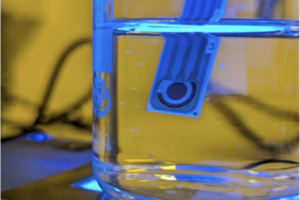
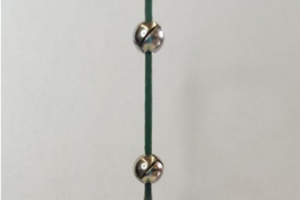
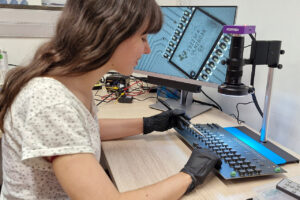
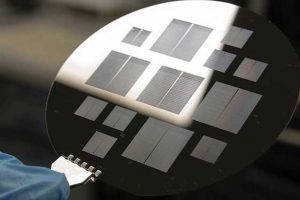
The MNT group has participated in all the versions of the wind sensor for the MEDA's instrument, which includes 60 silicon microchips made in UPC, manufactured in the Sala Blanca laboratory on the North Campus of the UPC, in Barcelona. The chips will be used to measure wind direction and speed. The MEDA wind sensor is composed of two cylindrical arms that will come out of the mast of the Mars2020 rover. Like the previous sensors REMS and TWINS, the wind speed and direction are obtained by measuring the tangential wind speeds at different points of each cylinder. In each of these points there are four silicon chips and an additional chip to detect the air temperature. Tangential wind speeds are obtained by monitoring small changes in heat transfer in each block (set of four chips) to the air.
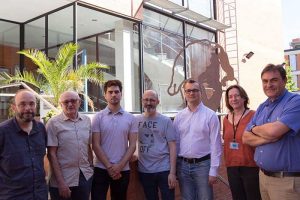
The team of scientists will also participate in calibrating the sensor and in the future recovery of data from Mars, to contribute to a better estimation of the wind and thus a better analysis of the atmospheric dynamics.
Technology
You want to know more?
Related Projects
- The MICROTECH LAB - Microtechnology for the Industry research subgroup, part of the Centre for Advanced Technologies in Mechanics (CATMech) at the Universitat Politècnica de Catalunya - BarcelonaTech (UPC), is leading the technical development of a minimally invasive platform to monitor biomarkers and physiological indicators related to stress and emotional wellbeing.
- A research team from the Universitat Politècnica de Catalunya - BarcelonaTech (UPC) has participated in the M3LEC project, coordinated by the Centro de Astrobiología (CAB), a joint centre of the Spanish National Research Council (CSIC) and the Instituto Nacional de Técnica Aeroespacial (INTA), with the Universidad de Sevilla (US) / Instituto de Microelectrónica de Sevilla (IMSE) also participating. M3LEC aimed to contribute to the characterisation of the Martian atmosphere and meteorology, and to investigate new instrumentation for future planetary exploration missions.
- A team from the Matrix Analysis and Discrete Potential Theory (MAPTHE) research group at the Universitat Politècnica de Catalunya - BarcelonaTech (UPC), and the Department of Mathematics at CUNEF Universidad in Madrid, have participated in the development of MARIA, a prototype of a portable, flexible and radiation-free device designed to improve the early detection of breast cancer. The device can identify tumours through electrical conductivity, with the aim of enabling its future use in primary care settings.
- The Center for Industrial Equipment Design (CDEI-UPC) at the Universitat Politècnica de Catalunya - BarcelonaTech (UPC) is participating in a cross-border project aimed at promoting the use of advanced digital technologies in viticulture in regions on both sides of the Pyrenees. The initiative seeks to improve specialist training, technical advice and decision-making in vineyard management.