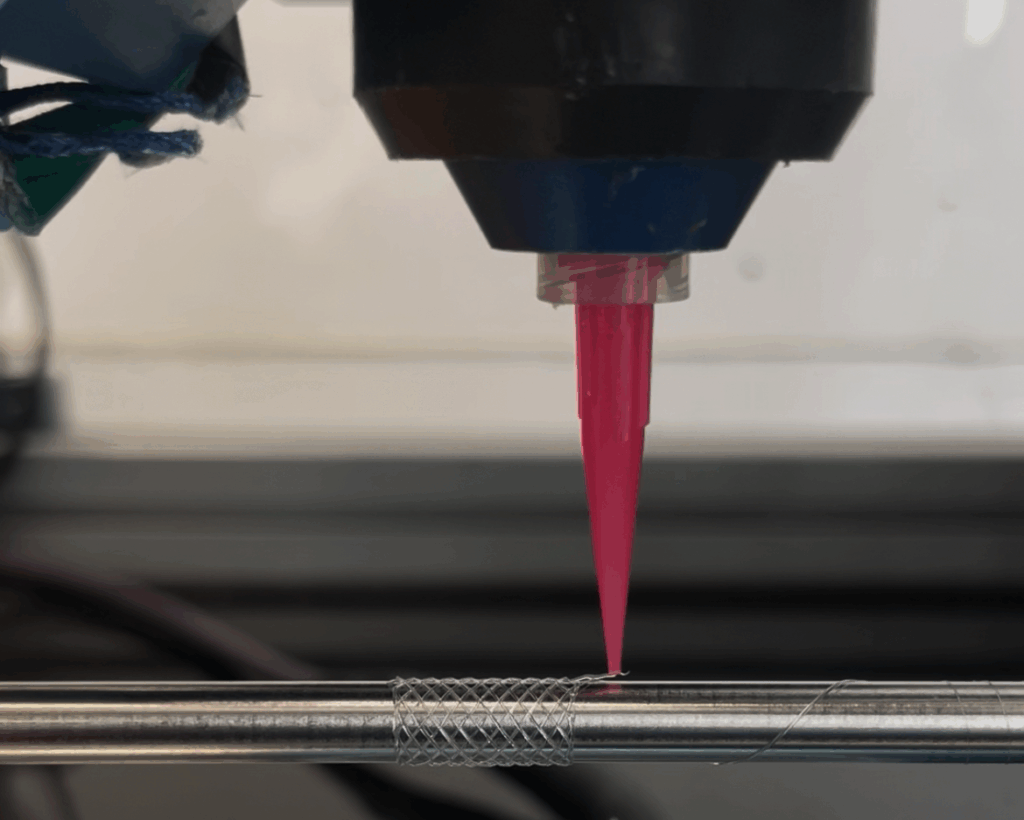
- The research groups in Biomaterials, Biomechanics and Tissue Engineering (BBT) and the Barcelona Research Center in Multiscale Science and Engineering (CCEM) at the Universitat Politècnica de Catalunya – BarcelonaTech (UPC) have developed biodegradable shape-memory stents for pediatric patients with aortic coarctation.
- A team from the Bioinspired Oral Biomaterials and Interfaces (BOBI) research group at the Department of Materials Science and Engineering (CEM) of the Universitat Politècnica de Catalunya - BarcelonaTech (UPC) is taking part in the European project HYDROHEAL, which explores how to transform bone fracture treatment using smart and advanced biomaterials, aiming to reduce the risk of infection and implant rejection, as well as shortening fracture recovery times.
- A team led by the Electronic and Biomedical Instrumentation (IEB) research group at the Universitat Politècnica de Catalunya - BarcelonaTech (UPC) is developing an electronic chip that enables more objective detection of potential infractions in race walking, which are currently judged solely by visual observation. The technology, already tested in official competitions, provides accurate, objective, and fair data on race walkers’ loss of ground contact.
- The Biomaterials, Biomechanics, and Tissue Engineering (BBT) Research Group at the Institute for Health Research and Innovation (IRIS) of the Universitat Politècnica de Catalunya – BarcelonaTech (UPC) is leading DYNAMIC, a project aimed at creating multifunctional, stimuli-responsive biomaterials that not only promote bone regeneration but also intelligently and effectively combat bacterial infections.
- 30/09/2024Project Headerrightno-repeat;left top;;auto20px A team from the Centre for Research in Biomedical Engineering (CREB) of the UPC and Sant Joan de Déu has created a new […]
- The research groups Soft Computing Research Group (SOCO) and Knowledge Engineering Research Group (GREC) at UPC are developing a personalised medicine platform to improve psychological treatment for psychosis. Using predictive models, the tool will foresee the effectiveness of therapy to tailor treatment. The prototype will be tested in a year-long clinical trial with patients worldwide.
- The Radio Frequency Identification and Flexible Electronics (RFLEX) group of the Universitat Politècnica de Catalunya - BarcelonaTech (UPC) is participating in the TELEBREATH project to better address the demand for long-term care in vulnerable groups, such as elderly and dependent people.
- A team of researchers from the Manufacturing Technologies Research Group (TECNOFAB) at the Universitat Politècnica de Catalunya - BarcelonaTech (UPC) has participated in BRUVIT. The aim of this project is to develop and validate the ball burnishing process assisted by ultrasonic vibration to improve the hardness and surface integrity of parts on a parallel lathe.
- The Radio Frequency Identification and Flexible Electronics (RFLEX) group at the Universitat Politècnica de Catalunya - BarcelonaTech (UPC) is participating in ETEXHEALTH. The project is focused on finding solutions based on the application of electronic textile sensors (e-textile) to monitor biometric variables of the human body and the evolution of diseases in a minimally invasive way.
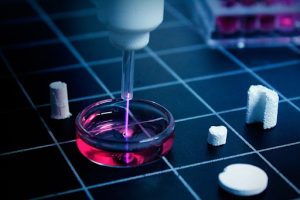
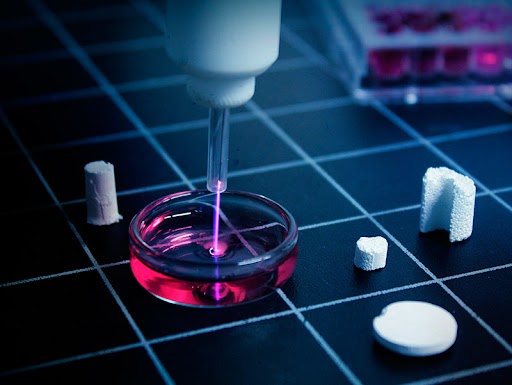
- The technology of the CP4C project, based on hydrogels treated with plasma gas, is being developed by the team of researchers at the PlasmaMedLab and the Biomaterials, Biomechanics and Tissue Engineering Group (BBT) of CREB at the UPC. CP4C is one of the University projects that has obtained a grant from Barcelona Deep Tech Node to accelerate its launch on the market.
- A multidisciplinary team whose participants include the Microbiology Service of the Vall d’Hebrón University Hospital, the Microbiology research group of the Vall d’Hebron Research Institute (VHIR), the Computational Biology and Complex Systems Group (BIOCOM-SC UPC), the Image and Video Processing Group (GPI) and the Database Technologies and Information Management Group (DTMI) at the Universitat Politècnica de Catalunya - BarcelonaTech (UPC), and Fundación Probitas, have presented a new diagnostic method for malaria based on artificial intelligence.
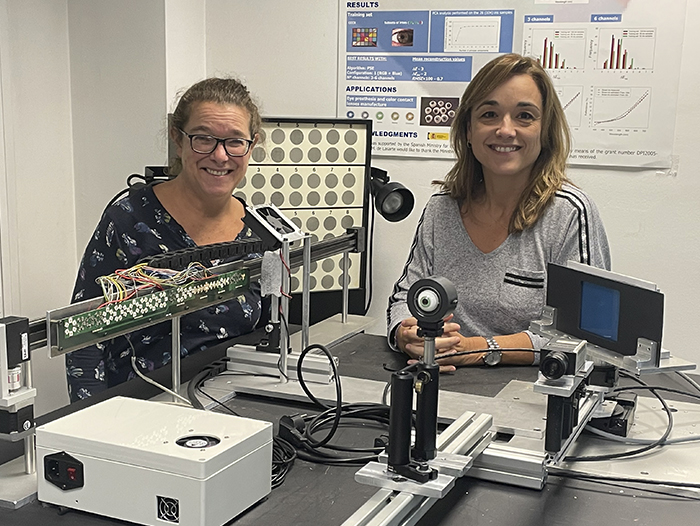
- An international consortium of universities, hospitals and companies, led by the Centre for Sensors, Instruments and Systems Development (CD6) at the UPC, is developing new technologies based on light and artificial intelligence to improve the diagnosis of various diseases.
- Participants in the HybridNeuro project include researchers from the group BIOART, which is part of the CREB of the UPC. The project is designed to establish a new way of analysing the motor system and human musculoskeletal movements, and the transfer of academic research to clinical practice and industry.
- The Centre for Sensors, Instruments and Systems Development (CD6) at the Universitat Politècnica de Catalunya - BarcelonaTech (UPC) is taking part in PhotonHub Europe. This is a European project to establish a single pan-European hub for innovation in photonics as a one-stop shop solution that brings together the pioneering photonics solutions, facilities, knowledge and experience of 53 European partners.
- Researchers from the Plasmas for BioMedical Applications Laboratory (PlasmaMED Lab) of the Department of Materials Science and Engineering of the Universitat Politècnica de Catalunya - BarcelonaTech (UPC), are working to develop a new treatment for bone cancer, which avoids the secondary effects of conventional treatments – such as chemotherapy – and enables bone regeneration when the tumour has been surgically resected.
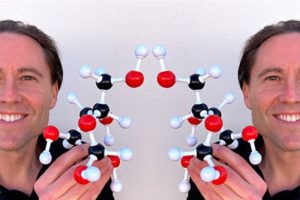
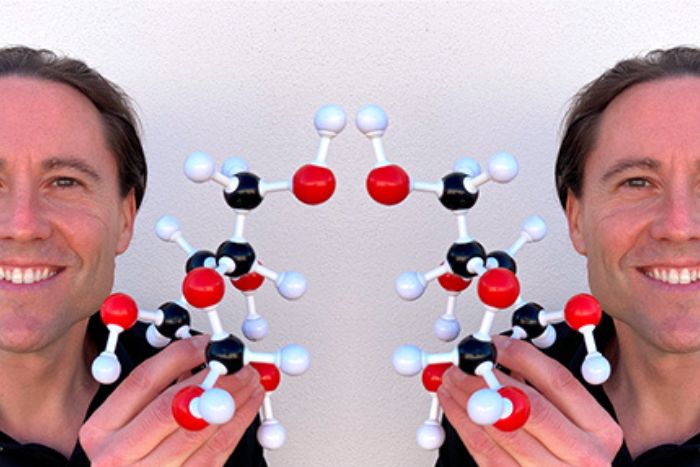
- The research group Polyfunctional Polymeric Materials (POLY2) of the Universitat Politècnica de Catalunya - BarcelonaTech (UPC) will work on the project CELICOIDS - Nanohelicoid metamaterials templated by cellulose nanocrystals with end-tethered polymers. As part of this project, it will develop new metamaterials −materials designed to have a property that is not found in nature – that can increase the spectroscopic sensitivity to distinguish molecular chirality.