

- All
- Agricultura
- agrotech (antiguo)
- Agrotech (antiguo)
- Agua
- Aigua
- Alimentación, agricultura y medio marino
- Audiovisual
- Automoción
- Big Data
- Biomateriales
- blockchain
- Ciberseguridad
- Economía Circular
- Enertronic
- Enertrònica
- Food, agriculture and the marine environment
- Green Car
- IAQ
- ict
- Indoor air quality
- Industria 4.0
- Industry
- Inteligencia Artificial
- Internet of Things
- Materiales de frontera
- Materiales de frontera
- microxips
- Mobile Technologies
- Open innovation
- Óptica y fotónica
- Qualitat de l’aire interior (IAQ)
- Realidad Virtual y Realidad Aumentada
- Robótica y Visión
- Sector Salut
- Smart City
- Smart Grids
- Technology
- Tecnologías de Agrotech
- Tecnologías de Infraestructuras
- Tecnologías de la Energía
- Tecnologías de la Producción
- Tecnologías de la Química
- Tecnologías de la Química
- Tecnologías de la Salud
- Tecnologías de la Transformación Digital
- Tecnologías de Logística y Movilidad
- Tecnologías de los Materiales
- Tecnologías de Urbanismo y Sostenibilidad
- Tecnologías del Medio Ambiente
- Tecnologías Químicas y de la Alimentación
- UPCxels
- Water
- Wood
- X
- Researchers at the Universitat Politècnica de Catalunya - BarcelonaTech (UPC) have developed a unique infrastructure serving the UPC, research centres and companies for the experimentation and validation of technologies and services using next-generation networks. This platform enables the validation of 5G solutions in real-world scenarios and leads research towards 6G, facilitating technology transfer to the market.
- The Barcelona Innovative Transportation (BIT), the Research Center in Automotive and Advanced Mobility (CER-AMA) and The Future Mobility Research Hub (CARNET) research groups from the Universitat Politècnica de Catalunya - BarcelonaTech (UPC) are participating in the E-MED project, which aims to optimise energy and resource efficiency in public transport systems by addressing energy price fluctuations through smart and participatory solutions across the Mediterranean region.
- A research team involving the Barcelona Innovative Transportation (BIT), inLab FIB, CARNET Barcelona – Future Mobility Research Hub (CER-AMA), and the Department of Computer Architecture (DAC) of the Universitat Politècnica de Catalunya - BarcelonaTech (UPC) is driving the i-MovE project, which aims to incorporate multisectoral data to provide much more accurate and valuable information for the mobility sector. The project develops four use cases focused on both companies and mobility authorities, covering public and individual transport, using the UPCxels demonstrator.
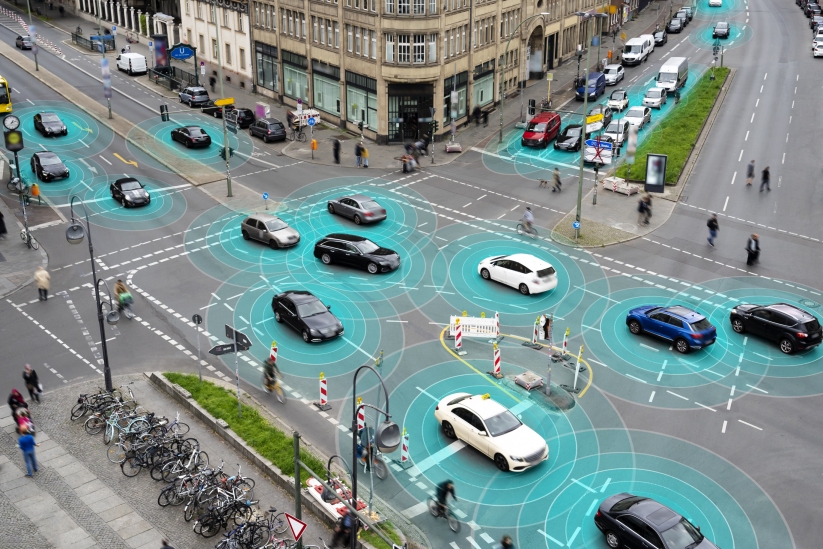
- The Research Center for Supervision, Safety and Automatic Control (CS2AC-UPC) at the Universitat Politècnica de Catalunya - BarcelonaTech (UPC) has coordinated the SaCoAV project, focused on researching new methods and tools to ensure the safe coordination of autonomous vehicles in urban environments.
- As part of the USEFUL project, the Centre for Sensor, Instrumentation and Systems Development (CD6) at the Universitat Politècnica de Catalunya - BarcelonaTech (UPC) has equipped a low-emission vehicle that will drive through the streets of Terrassa with optical sensors integrated into a complex system for data computing, visualisation, and storage. This car will collect and store thousands of anonymous driving data points, which will be used to develop more accurate algorithms for autonomous driving.
- The research and innovation laboratory at the Barcelona School of Informatics (inLab FIB) of the Universitat Politècnica de Catalunya - BarcelonaTech (UPC) is taking part, along with the distribution company Assolim, in the design of a test of concept to create optimised routes for each vehicle for transport on demand.
- A team of researchers from the Acoustic and Mechanical Engineering Laboratory (LEAM) in the Centre for Advanced Technologies in Mechanics (CATMech) at the Universitat Politècnica de Catalunya - BarcelonaTech (UPC) is participating in the development of a method that can generate and update noise maps for cities via mobile acoustic sensors.
- A multidisciplinary team at the Universitat Politècnica de Catalunya - BarcelonaTech (UPC) is working on the European project AI - Enhanced Fibre -Wireless Optical 6G Network in Support for Connected Mobility (6G-EWOC) to develop technologies and a 6G optical network that will combine artificial intelligence with 6G technologies, remote sensing systems and optical communication (wireless and by optical fibre). The result will be a network that will enable autonomous and human-driven vehicles to circulate safely, avoiding accidents in zones that have a lot of traffic or are very busy.
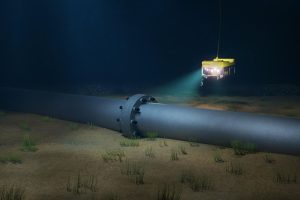
- CD6 researchers at the UPC participate in a project to design and construct a proof of concept of a system that has laser technology and sensors to detect and map the underwater environment.
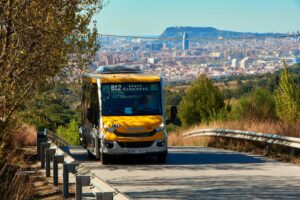
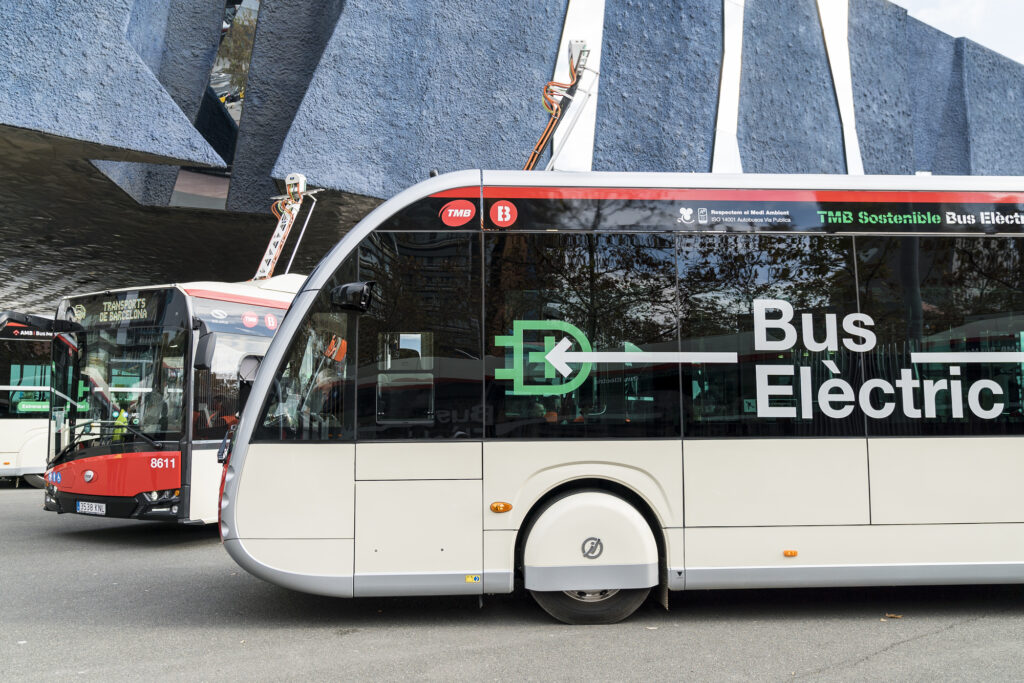
- The research group Barcelona Innovative Transportation (BIT) and the innovation and research laboratory of Barcelona School of Informatics (inLab FIB) at the Universitat Politècnica de Catalunya - BarcelonaTech (UPC) is taking part in the project eBRT2030 (European Bus Rapid Transit of 2030: electrified, automated, connected).
- MobilitApp is an application capable of predicting the mode of transport used by citizens using a deep learning tool based on three mobile phone sensors.
- Autonomous vehicles are a reality that we are getting closer to gradually but inevitably. The Centre for Sensors, Instruments and Systems Development (CD6) of the Universitat Politècnica de Catalunya - BarcelonaTech (UPC) has developed technologies for this type of vehicles that improve safety on journeys. To meet the needs of perceiving the environment at long range, a very complete set of sensors has to be developed, including cameras, LIDAR (Light Detection and Ranging) and radar.
- The aim of ANEM, in which SISCOM of the UPC participates, has been to develop, using latest generation models and techniques, a modular platform that can generate synthetic data (that is, not real data but data that can be used to train the artificial intelligence), protected from potential threats in the area of cybersecurity.
- The mobility of the future must be more intelligent, sustainable and connected. In this context, the project ‘Solutions for smart mobility’, with the participation of the Laboratory of the Barcelona School of Informatics (inLab FIB) of the Universitat Politècnica de Catalunya - BarcelonaTech (UPC), has developed a predictive model for the occupation of passengers in public transport buses based on deep learning methods.
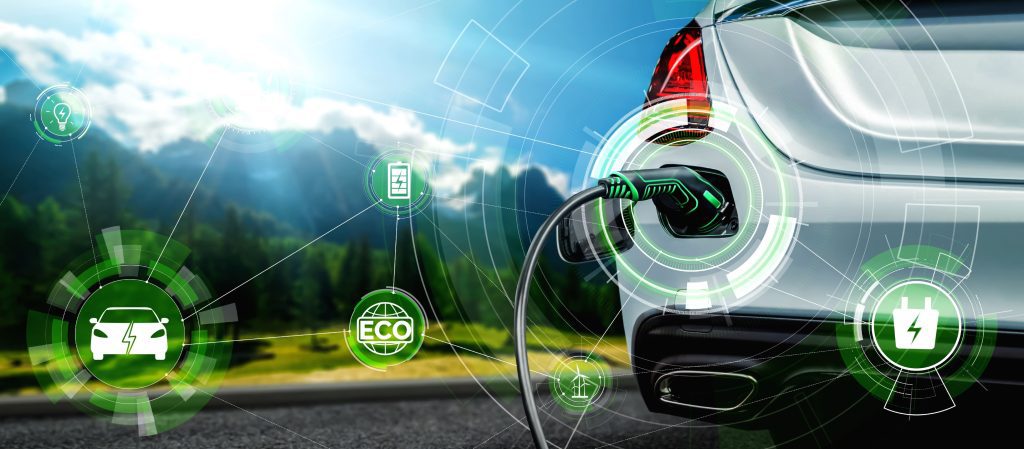
- The SCAPE project has been developed with the participation of the Power Electronics Research Group (GREP) of the Universitat Politècnica de Catalunya - BarcelonaTech (UPC). The aim is to advance towards design standardisation, cost reduction and an improvement in the features of electronic power conversion systems for the future generation of electric vehicles.
- The Motion Control and Industrial Applications (MCIA) centre, the Terrassa Industrial Electronics Group (TIEG) and the Environmental Engineering (ENMA) group of the UPC participate in RHODaS, a project to improve integrated motor propulsion systems for multiple drive architectures with more efficient materials, new semiconductors, better heat management and standardisation of manufacture of power convertors.